Jewelry on camera: where AI video still fails at sparkle
Sparkle is the one thing generation still cannot fake, because a highlight is an answer to where the light, the surface and the lens are, all at once. Six tells you can check in under a second, the twenty-minute macro session that supplies a whole campaign, and what to generate around it.
What is in here
Sparkle is the hardest thing to fake because a specular highlight is not a property of the object. It is a function of the light position, the surface curvature and the camera position at the same instant, and every highlight on a piece has to move together as any one of those changes. A generator samples a plausible appearance rather than solving for a reflection, so the sparkle looks right in a still and swims in motion. Shoot the actual piece in macro and generate everything around it.
- Why a highlight is a three-way answer, and why that makes it the last thing generation will get right
- Six specific tells, from the highlight that cross-fades instead of snapping to the chain that changes link count
- The split that works: real macro of the piece as the spine, generation for everything the piece is not in
- A twenty-minute macro setup that supplies sparkle for a whole campaign
- The rule that keeps a still honest: move the light, never the object
Four numbers we work to on jewelry
Measured in this studio01Why does AI video get jewelry wrong?
Because a highlight belongs to the situation, not to the object. A bright spot appears on a polished surface only where that surface points exactly halfway between the light and the lens, and its size is set by how rough the surface is. Move the lamp, the piece or the camera and every highlight on the piece relocates at once, together, obeying the same rule.
A generator is not solving that. It is producing a frame that looks like frames it has seen, which means the sparkle is convincing in any single image and uncoordinated across a sequence. Nothing enforces that the highlight on the left bead and the highlight on the right bead agree about where the window is.
Five places a viewer's eye lands on a jewelry frame
Tap the points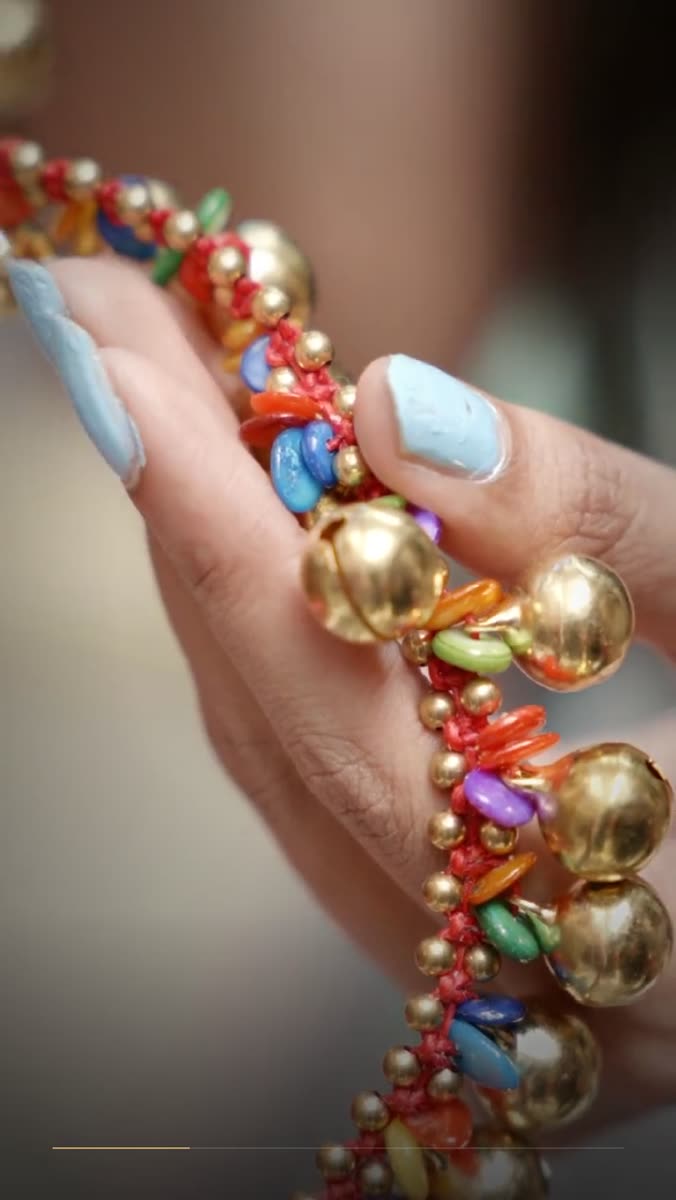
This is why jewelry is harder for generation than furniture, food or apparel. A sofa is mostly diffuse: light hits it, scatters, and looks about the same from anywhere. A ring is mostly specular. Almost everything you see on it is a reflection of something else, which makes it a claim about a room that was never built.
A sofa looks like itself from anywhere in the room. A ring looks like the room.
the line we use to explain why this category is different
02What fails, specifically
Six tells, in the order we catch them. All six are visible in under a second at feed size and none needs a trained eye. Somebody who cannot name one of them will still tell you the ad feels cheap, and they will be right.
Six things a real piece does, and what a generated one does instead
Side by side| Dimension | Real macro of the actual piece | Generated jewelry |
|---|---|---|
| A highlight as the camera moves | Yes. Snaps on and off as each facet crosses the angle | Cross-fades and swims, like a light seen under water |
| What the metal reflects | Yes. The window, the shaping, the hand, the lens | A smear that belongs to no room and does not turn with the object |
| Size against a body | Yes. Fixed. The band, the link, the lobe do not negotiate | Drifts between shots, and drifts large |
| Gold | Yes. Almost no scatter. One small hard highlight, and real darkness beside it | A yellow base with a broad soft sheen, which is what plastic looks like |
| A faceted stone | Yes. Returns light from inside itself and splits it into color | A lit blob with a white highlight painted on the front |
| A chain at rest | Yes. One continuous curve, constant link count and gauge | Links appear, merge and change thickness between frames |
The one that is hardest to unsee
Watch a real brilliant-cut stone turn under a fixed light. Individual facets go from black to blazing in a frame or two, then out again, and the pattern is discontinuous because each facet is a separate flat mirror crossing the angle at its own moment. Generated stones do the opposite. They glow, dim and glow, smoothly, all over, at once.
That smoothness is the giveaway, and once you have seen it you cannot unsee it. It is also why a slow camera move is the worst thing you can ask a generator to do with jewelry. A slow move gives the viewer time to watch the highlights behave, which is the evidence you did not want on screen.
03Why does the eye catch it when nobody can explain it?
Because specular motion is one of the ways people work out the shape of a surface in the first place. The highlight sliding across a curve is not decoration, it is data, and the visual system is reading it whether or not anyone is paying attention. When the data contradicts itself, the conclusion arrives before the explanation does.
04So what actually works?
Real macro of the actual piece as the spine, generation for everything the piece is not the subject of. That split is not a compromise, it is the cheapest correct answer. Twenty minutes of macro on a tripod supplies the six moments in the table above, and generation supplies the environment, the coverage, the hands out of focus, and the volume you could never afford to shoot.
How a jewelry campaign gets built here
The order that worksThe discipline that keeps the seam invisible is boring and absolute: the product's own surface is never generated, and never re-lit by a generator either. If a shot needs the ring to turn, a camera turns it. If a shot needs a mood, a generator builds the mood and the ring stays out of it. There is more on which categories tolerate this split in what kinds of products AI UGC actually works for.
What a jewelry beat is made of, seen from the side
Layer anatomyMove the light, not the object
This is the rule that took us a kill to learn, on bread rather than gold. We built a photographed loaf pulling apart into halves: grounded, shadowed, color-matched, clearing every automated check we had. It was killed on sight, and the note was three words long: that is not really how two pieces of bread separate.
The physical-plausibility rule, as a build spec
Copy it into your own specstill_or_cutout:
allowed: push | settle | drift | traveling_light
refused: rotate | split | pour | tear | deform
exception: a declared stylized treatment, e.g. papercut or halftone,
because it never claims the event was real
note: real physical events come from real footage
or from true video generation, never from a photographThe law we wrote from it applies to a ring exactly as it applies to a loaf. A still may move as a card - push, settle, drift, or have a patch of light travel across it - and it may never perform a physical event it would have to invent geometry for. A photograph of a ring cannot become a ring turning. It can become a ring the light moves over, which is the shot you wanted anyway. The full version of that argument is in the physics tests current video models still fail.
Fifteen seconds, split between what is shot and what is made
Second by secondRead it as a list
| At | Channel | What happens |
|---|---|---|
| 0.0s | Real macro | Light crosses the stone |
| 1.2s | Generated | Room, table, morning |
| 2.8s | Real macro | The chain falls |
| 4.6s | Generated | Hands, product out of focus |
| 6.4s | Real macro | Facets crossing the angle |
| 8.6s | Generated | Wardrobe and weather coverage |
| 11.2s | Real macro | Clasp, hallmark, scale on a hand |
| 13.4s | Generated | End card |
05The two-minute test, applied to a ring
We once delivered ten static creatives that were clean, on brand and scored fifty out of a hundred against a bar of eighty-five. The verdict was not about execution: we had put text on an image, and a client who could do that in two minutes has no reason to pay for it.
Three frames where the surface is doing the selling
Ours, three surfacesFor jewelry that verdict has a specific meaning. A photograph of a ring with a serif headline over it is a product page, not an ad. What clears the bar is assembly: a deconstruction, an arrangement of the whole collection in one composition, a range laid out as a sensory catalog, a piece built up element by element on screen. Craft the client can see they did not have.
Try your own line over a jewelry macro
Type into it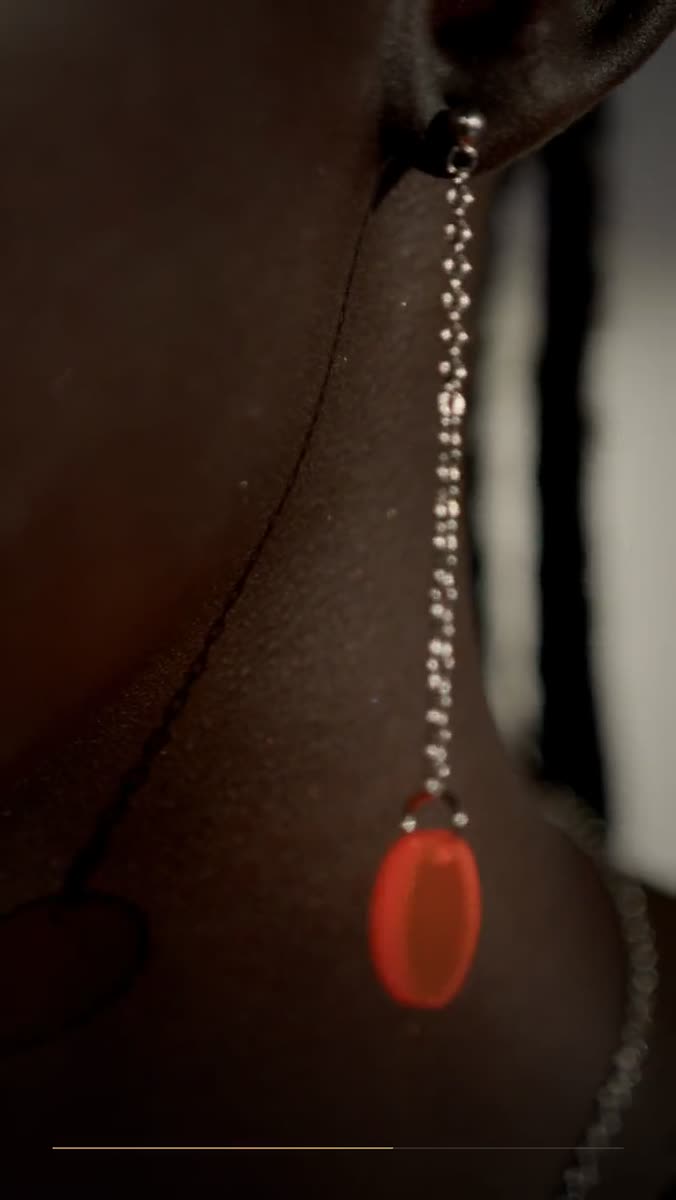
The twenty-minute macro session that carries a campaign
Tick as you go - it remembers06The six tells are today's list, not a permanent one
No jewelry cut we have made carries a click-through rate, so everything above is a craft argument about what a viewer can detect rather than a claim about what sells. Models also improve, and every one of the six is a tell somebody is being paid to remove. Re-run them yourself against whatever you are being sold this month rather than trusting a list dated last year.
Four things brands tell us about sparkle
Flip themThe failure we repeat most is asking a generated shot to hold too long. A generated environment at half a second is invisible and at two seconds it is an exhibit. Our own hard cap on shot length was retired because it was the wrong rule, but the instinct behind it was right for this category specifically. Jewelry punishes dwell more than any other product we work on, and a declared, obviously designed treatment is often the better escape.
The words for what is happening on the surface
Search the vocabularySpecular reflectionOptics
Diffuse reflectionOptics
The half-angleOptics
FireStones
Card moveMotion
Contact shadowCompositing
The two-minute testPitch
Questions people actually ask
Open what you needCan you make jewelry ads with AI?
Yes, as long as the piece itself is photographed. Generation handles the environment, the model coverage, the seasonal variants and the shot volume, and it should not be asked to render the product's own reflective surface. The useful mental split is that AI builds the room and the camera shoots the ring.
Why does AI-generated jewelry look fake?
Mostly because of how the highlights behave over time rather than how they look in one frame. A real facet snaps on and off as it crosses the angle between the light and the lens. A generated one fades up and down smoothly across the whole stone at once.
The second reason is what the metal reflects. Polished gold is a mirror and should contain a recognizable compressed picture of the room. Generated gold contains a soft smear that does not correspond to anything and does not turn when the object turns.
How do you film jewelry for ads without a studio?
A phone on a tripod, one small lamp behind a sheet of tracing paper, and a dark cloth. Lock the camera and sweep the light slowly past the piece, then lock the light and turn the piece slowly. Those two passes plus a scale reference against a hand give you almost everything a jewelry film needs.
Can I bulk create jewelry product videos with AI?
You can bulk create everything except the product. Once you have real macro of each piece, the surrounding film can be varied at volume: different rooms, different times of day, different arguments, different music. What does not scale is the macro pass, which is roughly twenty minutes per piece and is the one thing that cannot be borrowed from another SKU.
Is it cheaper to generate jewelry video than to shoot the piece?
Per second of footage, generation is cheaper. Per finished ad it usually is not, because the reshoot you avoid gets paid for later in rejected cuts and in a brand that reads as costume. The cheapest honest route is a short macro session per piece and generation for the rest, which is also the fastest once the macro exists.
Does this apply to gold as much as to diamonds?
It applies more. A stone at least gives a generator a bright shape to aim at. Polished metal has to carry a coherent reflection of a room across a curved surface while the object moves, which is the harder problem, and gold has the additional trap that its shadows stay colored rather than going neutral.
If you sell jewelry, the twenty minutes you spend photographing one piece under a moving light is worth more than any prompt you will write this year, because it is the only part of the ad a machine cannot currently give you and the only part your customer is actually inspecting.
Where the numbers came from
- Wikipedia. Specular highlight - for the half-angle rule and the roughness dependence quoted below, checked 1 September 2026
- arXiv. VideoPhy: Evaluating Physical Commonsense for Video Generation - for the general finding that generated video breaks physical commonsense
- PNAS. Simulation as an engine of physical scene understanding (Battaglia, Hamrick and Tenenbaum, 2013) - for why a viewer detects a wrong physical event without being able to name it
Every figure above links to the place it was published. Numbers marked as ours are measured inside this studio and we say so where they appear. We do not print a statistic we cannot point at.
Send a link. Get one finished ad back.
One finished cut built from your own product photography, inside three days, free and yours to run whether or not we ever work together. If your piece has never been shot under a moving light, we will tell you that too, and what it would take.
Replies within a day. Ad within three.